
Field Day
Table of Contents
Field Day was a success; see you all next year!
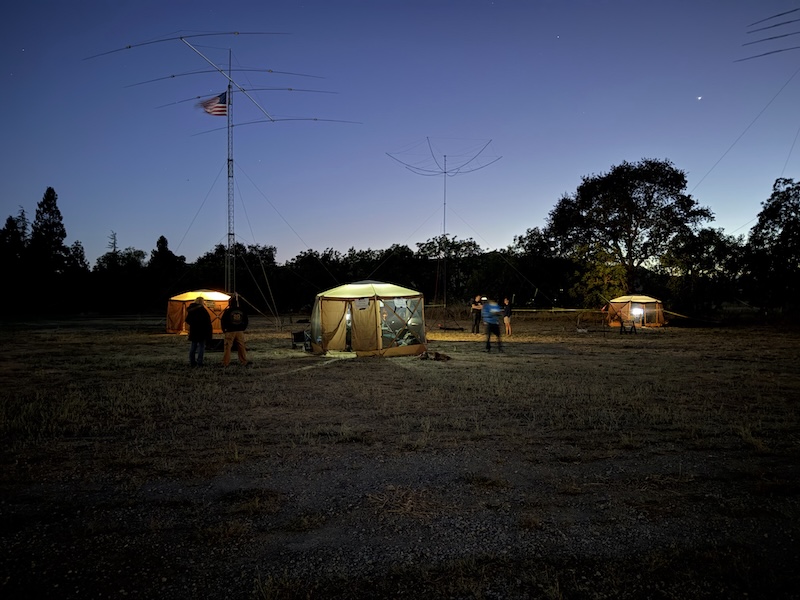
Click here for more pictures.
Radio Ranch, San Martin - 27-28 June 2026
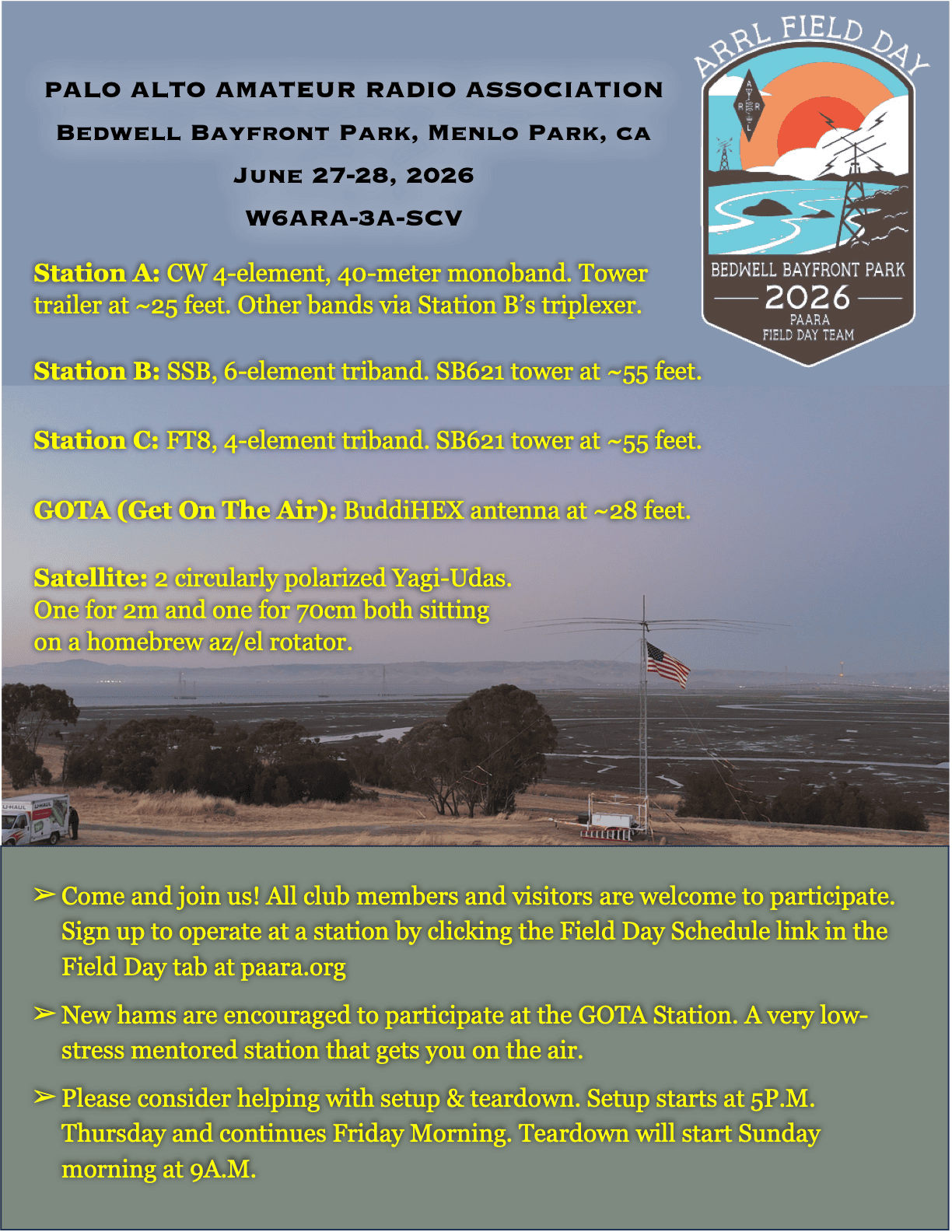
PAARA will be holding its annual Field Day event at Radio Ranch in San Martin on June 27 & 28.
Field Day T-shirts are expected to be completed in time to be passed out at the June 5th meeting. If you cannot make it to the meeting they will be available for pick up at the Field Day site during Field Day weekend. You can also pick up your T-shirt in Redwood City. Email Rob, at kc6tyd@paara.org, to coordinate a date and time.
Stations
We compete in Class 3A, running 3 primary HF stations, including a dedicated digital mode station running FT8 and FT4 on 20 Meters. Marty W6NEV captains this station.
In addition, we operate 2 other HF stations, running amplifiers to increase transmit power up to the 500-watt limit. Ric N6AJS captains our CW station, and Sorin KN6YUH the SSB Phone one.
Our intention is to keep these stations staffed and operating for the entire 24 hours of the event. That means there will be ample opportunities to work the biggest operating event of the year from excellent stations at Radio Ranch. Please sign up for some seat time. Advance sign-ups can be made on this Google Sheet.
As always, we have our excellent GOTA station to give interested visitors who have never been on HF the opportunity to operate under Ben’s KN6UBF guidance.
Rounding out the mix are UHF/VHF/satellite operations, captained by Justin AI6YM, featuring his impressive home-brewed azimuth/elevation rotor system for the satellite antenna array he has designed and built.
Antenna Parties
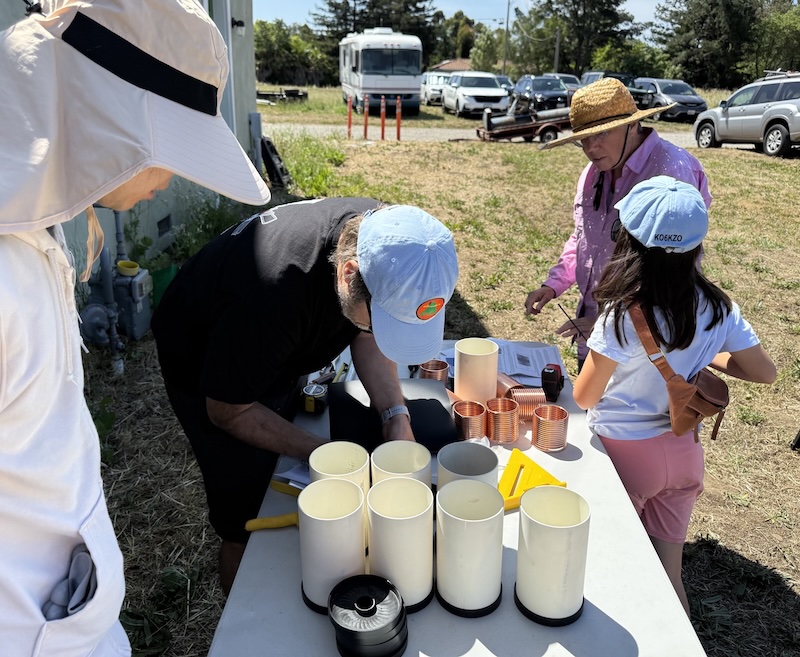
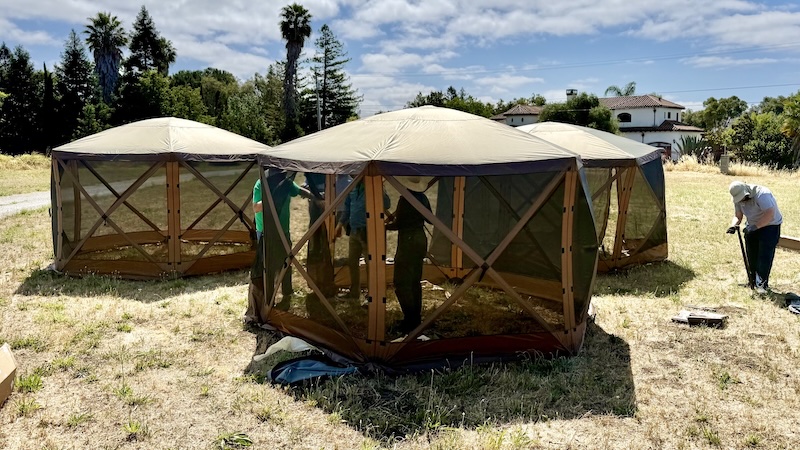
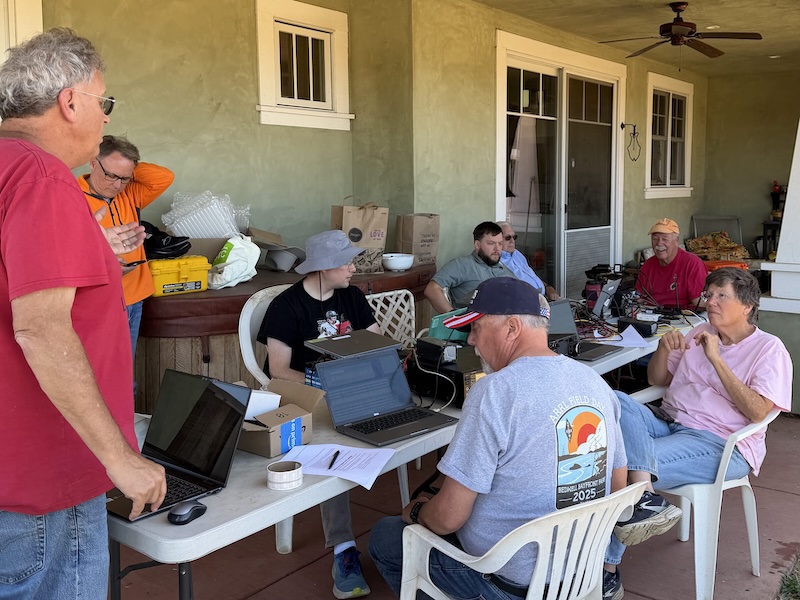
Advance preparation for Field Day will include 4 scheduled antenna work parties at Doug KG6LWE’s San Martin QTH, and Network Day to connect all the radios and logging computers on a couple of tables in Marty’s garage to work out any connection or communication issues before Field Day weekend.
We have always enjoyed these “work parties” and have found them to be good team-building opportunities, as well as good practice in assembling the antennas and getting them up in the air. If you’re interested in coming out for a couple of fun days in the sun with the team, please let Doug know.
The 4 scheduled antenna work parties are:
- May 16
- May 23
- May 30
- June 20
Others may be scheduled on an as-needed basis.
Antenna Party #1
Click here for more pictures.
Antenna Party #2
Click here for more pictures.
Antenna Party #3
Click here for more pictures.
Antenna Party #4
Click here for more pictures.
Network Day
Click here for more pictures.
Installation
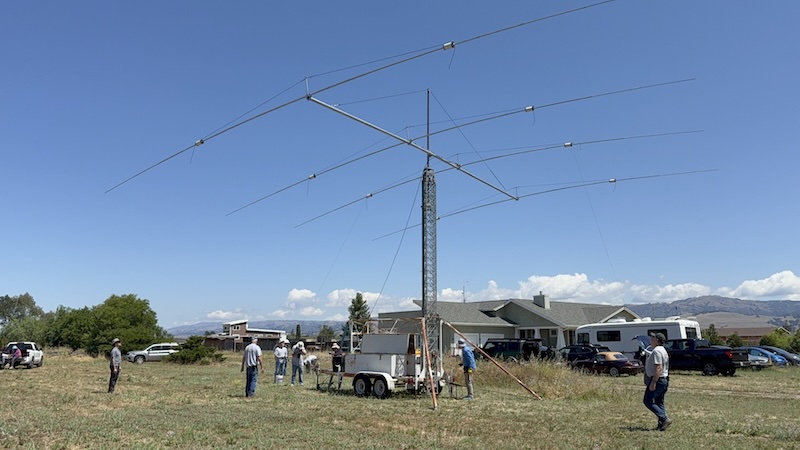
Installation setup at Radio Ranch begins Friday morning at 10:00 A.M., with the erection of one of our AB-621 military mast systems topped by our big triband KT-34XA beam antenna. Work continues with the erection of another AB-621, supporting the 20 Meter monobander for Marty’s digital station, followed by the assembly and erection of the monster 4 element 40 Meter beam on the tower trailer. An 80 Meter dipole is also strung up for nighttime operations. GOTA’s Buddihex antenna typically goes up Saturday morning.
Antennas and stations will be in the West field, with the socializing area to the left of the garage.
Running 3A means there’s plenty to do, so we’re looking for volunteers to help with setup and teardown. Many hands make light work of all of this, so please bring yours out to Radio Ranch to join the big team effort.
You work, we feed
As always, the You work, we feed rule will be observed, starting with burgers, hot off the grill at the San Martin work parties, with make-it-yourself sandwiches for lunch at Radio Ranch on Friday and Saturday, and hot soup and hot dogs for dinner Saturday night. Thanks to Rob KC6TYD for feeding us so well.
Questions
For questions about Field Day or to volunteer to help, you can contact PAARA’s Field Day Coordinator Doug KG6LWE at his new PAARA e-mail address, kg6lwe@paara.org (Thanks Sorin KN6YUH).
Safety Guidelines
You can read the 2026 Field Day Safety Guidelines by clicking here.
Please familiarize yourself with the following rules and site notes.
Radio Ranch Rules and Site Notes
- No smoking.
- Dogs are welcome but must be on leash; the property is not fully fenced.
- Everyone is welcome to stay for the entire event.
- Trailers and RVs are fine, but hookups will not be available.
- Use the East gate, closest to Monterey Road.
- Park only in the field to the right of the house. Follow posted signs.
- Antennas and stations will be in the West field; the social area will be to the left of the garage.
Past Field Days
Field Day By Jack Daane, KR6CD
Field day is an emergency communication exercise. Each year, during the last full weekend in June, amateur radio operators presume there has been a major disruption to electric power and commercial communication systems. The power is off, there is no local phone service, no long distance, no cell phone, no internet service, even some of the government radio systems have been knocked out. In response, amateurs assemble two-way radio stations operating on emergency power to transmit messages over the amateur bands.
In a real emergency, radio amateurs would send messages, telegram style, for public officials over these stations. For example, the mayor might write a message to send to the governor, hand it to the radio amateurs who would then relay the message, station by station, to the state capital and deliver it. Similarly, the reply from the governor would be relayed back to the mayor.
That’s the idea behind field day, practice setting up a radio station on short notice and operate it on emergency power. Many amateur clubs such as PAARA take part.
Interested in participating? Well, there are three major activities to work on: moving and setup of the equipment on Friday, operating Saturday and Sunday, and then disassembly on Sunday. Everybody is welcome to join in.
First comes assembling the PAARA station on Friday. The electric generators, radios, towers, antennas, and shelters must be brought to the field day site and put together into working radio stations. This gives you a great hands-on opportunity to work with a variety of equipment. You’ll be piecing towers together, mounting antennas and rotators on them, threading transmission lines on them, and then hoisting them skyward. Down on the ground, there are power supplies and two-way radios to hook up. The generator has to be cabled to the radio equipment. You’ll see equipment you’ll never find in a radio store, and you actually get to use it, not just look at it.
Next comes operating the stations, starting on Saturday. There probably won’t be an actual disruption to commercial communication systems during field day, so instead of relaying telegrams for public officials, amateurs cont act one another to determine the range of each station.
Operators generally work in pairs at each radio. One person operates, the other logs contacts. The operator calls “CQ field day, CQ field day”, and gives the station’s call sign, W6OTX. When a distant operator responds to the call, the logger records the call sign and location of the far station. It is very similar to typical ham radio contesting, and clubs compete to see who gets the most points by contacting the most stations. This goes on for 24 hours straight, but obviously operators work in shifts of a few hours at a time.
During field day there are stations in the U.S., Canada, and many other countries participating on most of the amateur bands, including HF, VHF, UHF, and satellite. Most of the operating modes are used as well, such as CW, voice, packet, FAX, and even TV. Field day is a great opportunity to try a mode that you might not have at your own station.
PAARA typically has a CW and a SSB station on HF plus a station on VHF. Other bands and modes might also be used depending upon what the club members choose to do during field day.
Since a logger can serve as the control operator, you can be the radio operator and use modes that your own license class does not permit. For example, during field day, Technician class licensees can use voice or CW on the HF bands.
After the official field day operating period ends on Sunday, all that equipment has to come back down and go into storage for the next field day, or maybe a true communication emergency.
There is still work to do after field day weekend has past. The contact lists must be submitted to the ARRL for compilation. In addition, the field day planners get together to analyze the contact data to see where each station could reach, where it didn’t reach, and to revise the plan for the next field day in order to maximize the radio coverage area.
Field day is a lot of fun, a great way to work with a team of amateur radio operators, and try out the biggest variety of equipment you’ll probably ever see in one location.